
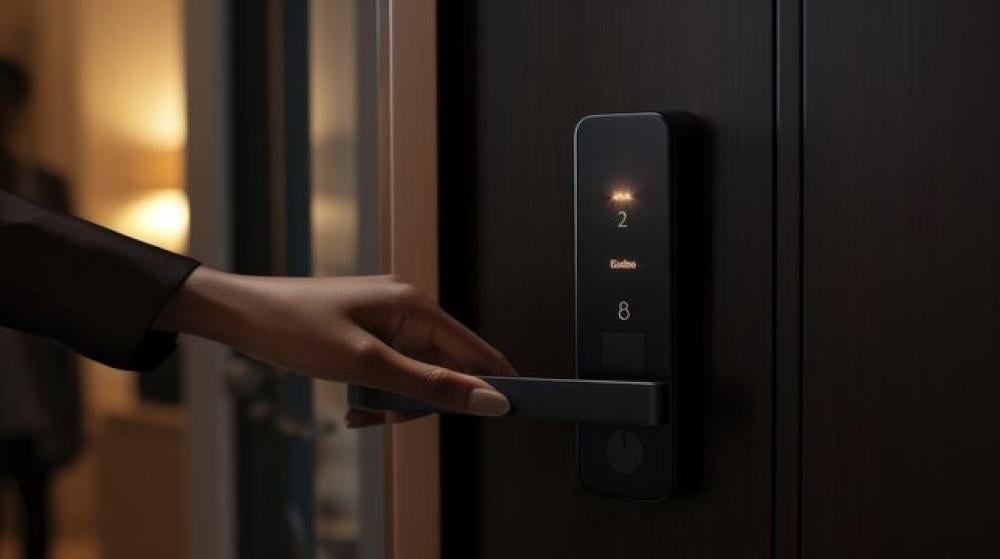
Perhaps you're looking for elegant doors for your home or office, and you've found what you're looking for at Al-Ghamlas. Let us serve you again and tell you that these beautiful doors need smart locks as a modern and contemporary alternative to traditional locks.
Smart locks promise more security, convenience, and control over access to your home and office.
But, as with any new technology, smart locks come with a set of advantages and disadvantages that we should understand before deciding to replace our old locks with them.
Before we urge you to buy a smart lock, let us tell you more about the advantages and disadvantages of using smart locks , so you can make your decision with confidence and love.
What are smart locks?
Smart locks are electronic locking devices that allow doors to be opened and closed without using a traditional key.
These locks rely on wireless communication technologies such as Bluetooth, Wi-Fi, and NFC to communicate with other devices such as smartphones, smart cards, or even smart home systems.
Smart locks can often be controlled remotely, allowing users to grant or revoke access to specific individuals, track entry and exit history, and even unlock the door for visitors remotely.
Smart locks come in a variety of designs, some of which completely replace a traditional lock, while others are mounted on the inside of the door while retaining the traditional locking mechanism as a backup option.
What are the advantages of using a smart lock compared to a traditional lock?
The name "smart" certainly doesn't come from nothing, as smart locks offer a range of advantages that make them an attractive option for many compared to traditional locks:
- Convenience and Accessibility: No need to worry about losing your keys or carrying them everywhere.
You can simply open the door using your smartphone, a PIN code, or even your fingerprint in some models.
This feature is especially useful when carrying items or when family members arrive without keys. This feature is the main answer to the question, " What are the advantages of using a smart lock over a traditional lock? "
- Enhanced Security: Many smart locks come with advanced security features such as encryption, tamper-evident alerts, and an entry and exit log that lets you know who entered and left and when.
Some integrate with alarm systems and home security cameras to increase security.
So if you're wondering whether a smart lock is better than a key lock? In terms of security, it definitely is!
- Remote control: Some smart locks allow you to open the door for guests or maintenance workers remotely using your smartphone, even if you're not home.
You can also temporarily or permanently revoke access permissions for anyone easily via the lock app.
- Ability to grant temporary or custom access permissions: You can create unique PINs or temporary digital keys for visitors or service providers, and specify their expiration period.
This feature eliminates the need to copy traditional keys and receive them later.
- Track entry and exit history: Most smart locks provide a detailed log of entries and exits, allowing you to monitor who entered and left your home and when.
This feature can be especially useful for families with children returning home alone or for owners of rental properties.
- Integration with smart home systems: Many smart locks can be integrated with other smart home systems like Amazon Alexa or Google Assistant, allowing you to control the lock using voice commands or make it part of your home automation scenarios.
What are the disadvantages of using electronic locks? (What are the weaknesses of a smart lock?)
Despite the many advantages, the use of electronic and smart locks comes with some disadvantages and weaknesses of the smart lock that should be taken into consideration:
- Power Dependence: Smart locks run on batteries or require a power supply. If the battery dies or the power goes out, you may not be able to unlock the door electronically. While most come with a low-battery alarm and a traditional keyless entry option as a backup, this remains a potential vulnerability. What are the disadvantages of using electronic locks? This includes their dependence on a power supply.
- Vulnerability to Hacking: Due to their reliance on wireless connectivity and software, smart locks may be vulnerable to hacking by sophisticated hackers. Although manufacturers are making great efforts to secure these devices, security vulnerabilities remain a possibility.
- Connectivity Issues: Smart locks may have problems connecting to Wi-Fi or Bluetooth, which can make it difficult to control them remotely or receive alerts.
- Compatibility: Some smart locks may not be compatible with all types of doors or existing lock systems, which may require complex modifications or installations.
Is a smart lock better than a key lock?
Overall: Yes, smart locks are considered better.
But there are some cases where a traditional lock may be less complex and therefore better.
Here are some scenarios:
- If you value convenience, remote control, and smart features: a smart lock may be the best choice for you.
- If you are concerned about electronic security and prefer the simplicity and reliability of traditional locks, a key lock may be the most secure and convenient option for you.
- Compromise: Some people prefer to choose smart locks that come with a traditional keyed opening option as a backup solution, combining the advantages of both types.
Types of smart locks
There are a variety of smart locks available on the market, and they differ in how they operate and their features:
- Bluetooth locks: These connect to your smartphone via Bluetooth and allow the door to be unlocked upon approach or via an app. They often consume less power but have a limited control range.
- Wi-Fi locks: Connect to your home Wi-Fi network, allowing you to control them remotely from anywhere via the Internet.
- PIN code locks: Allow the door to be opened by entering a numeric code on a keypad.
- Fingerprint locks: Use fingerprint recognition technology to unlock the door.
- Hybrid locks: combine more than one unlocking method, such as Bluetooth, code, PIN, and traditional key.
Remember that Al-Ghamlas offers you a variety of modern smart locks that suit your desire to develop and obtain the best and most comfortable home decor.
Smart locks represent an exciting development in home security, offering benefits and convenience that were not available before.
So it's good to know the pros and cons of using smart locks, and we hope this article has helped you.